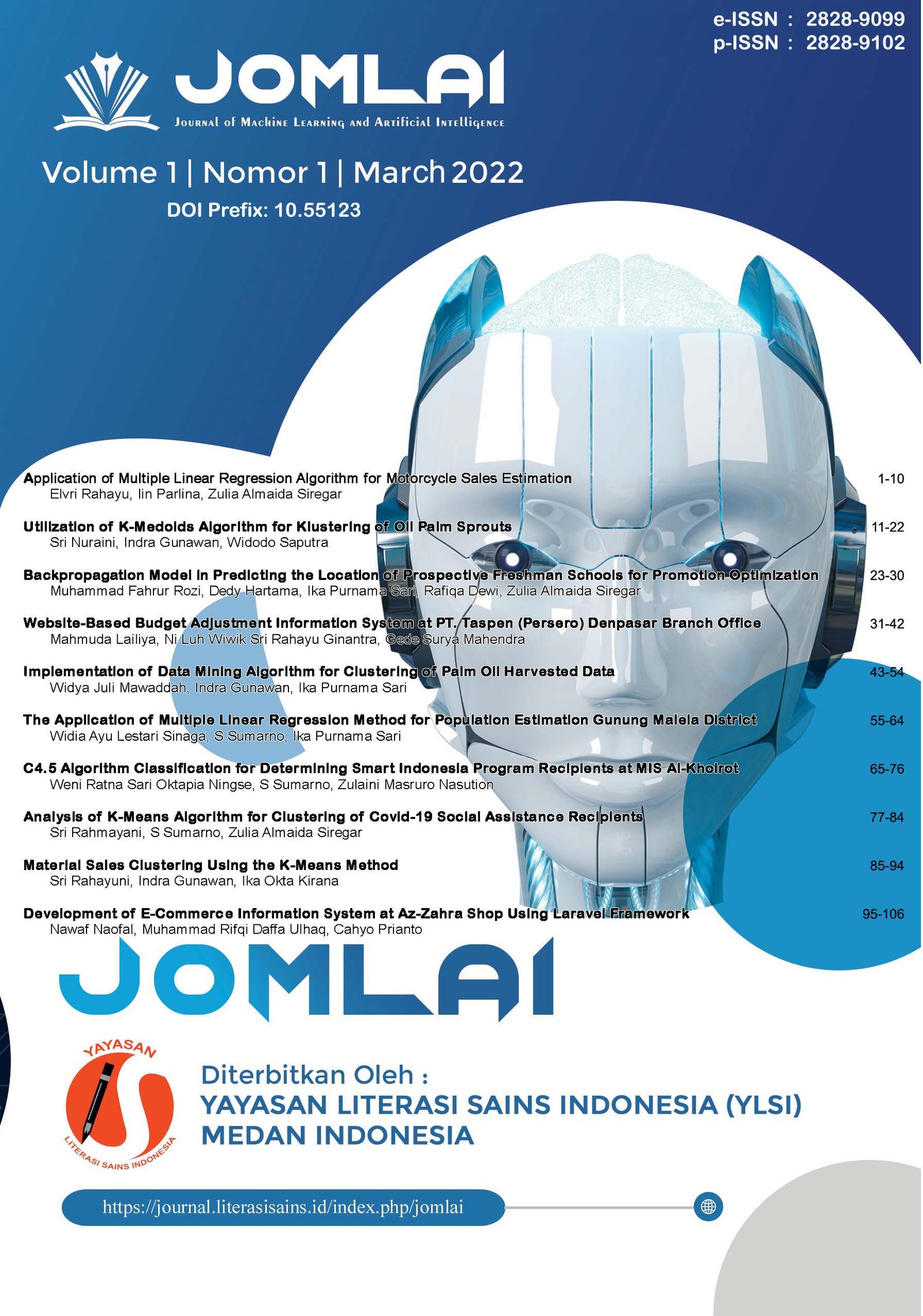
C4.5 Algorithm Classification for Determining Smart Indonesia Program Recipients at MIS Al-Khoirot
DOI:
https://doi.org/10.55123/jomlai.v1i1.165Keywords:
SIP, Data Mining, C4.5 Algorithm, Classification, MIS Al-KhoirotAbstract
The purpose of the research is to assist the school in selecting student data as recipients of the PIP (Smart Indonesia Program) to be more objective and practical and to assist in increasing the accuracy of the targeting of the recipients of the PIP funds. In this study using Data Mining techniques using the C4.5 algorithm. The source of the research data used was obtained from observations and interviews with the MIS Al-Khoirot Tambun Nabolon Pematang Siantar school. The research variables used were parents' occupations, parents' income, KKS (Prosperous Family Card) holders, SKTM holders (Poor Certificate). In this study, the alternative used as a sample is the data of MIS Al-Khoirot students. The results of this study found that the most dominant attribute was the SKTM holder with a gain of 0.833764907, besides that this study produced 8 (eight) rules with an accuracy rate of 98.00%. Based on this, it can be concluded that the C4.5 algorithm can be used for the classification of the Determination of Smart Indonesia Program Recipients at MIS Al-Khoirot
References
A. Wanto and E. Kurniawan, “Seleksi Penerimaan Asisten Laboratorium Menggunakan Algoritma AHP Pada AMIK-STIKOM Tunas Bangsa Pematangsiantar,” Jurnal Informatika dan Komputer (JIKO), vol. 3, no. 1, pp. 11–18, 2018.
V. V. Sianipar, A. Wanto, and M. Safii, “Decision Support System for Determination of Village Fund Allocation Using AHP Method,” The IJICS (International Journal of Informatics and Computer Science) ISSN, vol. 4, no. 1, pp. 20–28, 2020.
P. P. P. A. N. . F. I. R.H Zer, Masitha, A. P. Windarto, and A. Wanto, “Analysis of the ELECTRE Method on the Selection of Student Creativity Program Proposals,” Journal of Physics: Conference Series, vol. 1255, no. 1, pp. 1–6, Aug. 2019.
D. M. Sinaga, R. R, R. Alfah, A. P. Windarto, and A. Wanto, “Jurnal Sains dan Informatika,” Jurnal Sains dan Informatika, vol. 5, no. 2, pp. 129–135, 2018.
D. R. Sari, N. Rofiqo, D. Hartama, A. P. Windarto, and A. Wanto, “Analysis of the Factors Causing Lazy Students to Study Using the ELECTRE II Algorithm,” Journal of Physics: Conference Series, vol. 1255, no. 1, p. 012007, Aug. 2019.
T. Imandasari, A. Wanto, and A. P. Windarto, “Analisis Pengambilan Keputusan Dalam Menentukan Mahasiswa PKL Menggunakan Metode PROMETHEE,” Jurnal Riset Komputer (JURIKOM), vol. 5, no. 3, pp. 234–239, 2018.
R. Watrianthos, W. A. Ritonga, A. Rengganis, A. Wanto, and M. Isa Indrawan, “Implementation of PROMETHEE-GAIA Method for Lecturer Performance Evaluation,” Journal of Physics: Conference Series, vol. 1933, no. 1, p. 012067, 2021.
G. W. Bhawika et al., “Implementation of ANN for Predicting the Percentage of Illiteracy in Indonesia by Age Group,” Journal of Physics: Conference Series, vol. 1255, no. 1, pp. 1–6, 2019.
A. Wanto et al., “Analysis of the Backpropagation Algorithm in Viewing Import Value Development Levels Based on Main Country of Origin,” Journal of Physics: Conference Series, vol. 1255, no. 1, pp. 1–6, 2019.
E. Siregar, H. Mawengkang, E. B. Nababan, and A. Wanto, “Analysis of Backpropagation Method with Sigmoid Bipolar and Linear Function in Prediction of Population Growth,” Journal of Physics: Conference Series, vol. 1255, no. 1, pp. 1–6, 2019.
M. K. Z. Sormin, P. Sihombing, A. Amalia, A. Wanto, D. Hartama, and D. M. Chan, “Predictions of World Population Life Expectancy Using Cyclical Order Weight / Bias,” Journal of Physics: Conference Series, vol. 1255, no. 1, pp. 1–6, 2019.
A. Wanto et al., “Analysis of the Accuracy Batch Training Method in Viewing Indonesian Fisheries Cultivation Company Development,” Journal of Physics: Conference Series, vol. 1255, no. 1, pp. 1–6, 2019.
Y. Andriani, H. Silitonga, and A. Wanto, “Analisis Jaringan Syaraf Tiruan untuk prediksi volume ekspor dan impor migas di Indonesia,” Register: Jurnal Ilmiah Teknologi Sistem Informasi, vol. 4, no. 1, pp. 30–40, 2018.
W. Saputra, J. T. Hardinata, and A. Wanto, “Implementation of Resilient Methods to Predict Open Unemployment in Indonesia According to Higher Education Completed,” JITE (Journal of Informatics and Telecommunication Engineering), vol. 3, no. 1, pp. 163–174, 2019.
N. L. W. S. R. Ginantra et al., “Performance One-step secant Training Method for Forecasting Cases,” Journal of Physics: Conference Series, vol. 1933, no. 1, pp. 1–8, 2021.
N. Arminarahmah, A. D. GS, G. W. Bhawika, M. P. Dewi, and A. Wanto, “Mapping the Spread of Covid-19 in Asia Using Data Mining X-Means Algorithms,” IOP Conf. Series: Materials Science and Engineering, vol. 1071, no. 012018, pp. 1–7, 2021.
A. Pradipta, D. Hartama, A. Wanto, S. Saifullah, and J. Jalaluddin, “The Application of Data Mining in Determining Timely Graduation Using the C45 Algorithm,” IJISTECH (International Journal of Information System & Technology), vol. 3, no. 1, pp. 31–36, 2019.
T. H. Sinaga, A. Wanto, I. Gunawan, S. Sumarno, and Z. M. Nasution, “Implementation of Data Mining Using C4.5 Algorithm on Customer Satisfaction in Tirta Lihou PDAM,” Journal of Computer Networks, Architecture, and High-Performance Computing, vol. 3, no. 1, pp. 9–20, 2021.
N. A. Febriyati, A. D. GS, and A. Wanto, “GRDP Growth Rate Clustering in Surabaya City uses the K- Means Algorithm,” International Journal of Information System & Technology, vol. 3, no. 2, pp. 276–283, 2020.
J. Hutagalung, N. L. W. S. R. Ginantra, G. W. Bhawika, W. G. S. Parwita, A. Wanto, and P. D. Panjaitan, “COVID-19 Cases and Deaths in Southeast Asia Clustering using K-Means Algorithm,” Journal of Physics: Conference Series, vol. 1783, no. 1, p. 012027, 2021.
I. Parlina et al., “Naive Bayes Algorithm Analysis to Determine the Percentage Level of visitors the Most Dominant Zoo Visit by Age Category,” in Journal of Physics: Conference Series, 2019, vol. 1255, no. 1, p. 012031.
M. A. Hanafiah, A. Wanto, and P. B. Indonesia, “Implementation of Data Mining Algorithms for Grouping Poverty Lines by District/City in North Sumatra,” International Journal of Information System & Technology, vol. 3, no. 2, pp. 315–322, 2020.
I. S. Damanik, A. P. Windarto, A. Wanto, Poningsih, S. R. Andani, and W. Saputra, “Decision Tree Optimization in C4.5 Algorithm Using Genetic Algorithm,” Journal of Physics: Conference Series, vol. 1255, no. 1, pp. 1–7, 2019.
A. Wanto et al., Data Mining : Algoritma dan Implementasi. Yayasan Kita Menulis, 2020.
D. Hartama, A. Perdana Windarto, and A. Wanto, “The Application of Data Mining in Determining Patterns of Interest of High School Graduates,” Journal of Physics: Conference Series, vol. 1339, no. 1, p. 012042, Dec. 2019.
H. J. Jajam and N. I. P. Astuti, “PENERAPAN ALGORITMA C4.5 UNTUK PENENTUAN PENERIMA BEASISWA (Studi Kasus: SDN Karawang Kulon III) 1,” Ilmu Komputer dan Teknologi Informasi, vol. 3, no. 1, pp. 25–29, 2018.
R. Rismayanti, “Implementasi Algoritma C4.5 Untuk Menentukan Penerima Beasiswa Di Stt Harapan Medan,” Jurnal Media Infotama, vol. 12, no. 2, pp. 116–120, 2016.
D. Ardiansyah and W. Walim, “Algoritma c4.5 untuk klasifikasi calon peserta lomba cerdas cermat siswa smp dengan menggunakan aplikasi rapid miner,” Jurnal Inkofar, vol. 1, no. 2, pp. 5–12, 2018.
R. Z. Nainggolan, K. Ibnutama, and M. G. Suryanata, “Implementasi Data Mining Dengan Metode Regresi Linier BergandaDalam Estimasi Mahasiswa Baru Pada SekolahTinggi Agama Islam Raudhatul Akmal BatangKuis,” Jurnal CyberTech, vol. 1, no. 1, pp. 13–20, 2021.
Downloads
Published
How to Cite
Issue
Section
License
Copyright (c) 2022 Weni Ratna Sari Oktapia Ningse, S Sumarno, Zulaini Masruro Nasution

This work is licensed under a Creative Commons Attribution-ShareAlike 4.0 International License.
Copyright (c) 2022 The authors. Published by Yayasan Literasi Indonesia  This work is licensed under a Creative Commons Attribution-ShareAlike 4.0 International License
The author(s) whose article is published in the JOMLAI journal attain the copyright for their article and grant the journal right of first publication with the work simultaneously licensed under a Creative Commons Attribution-ShareAlike 4.0 International License. By submitting the manuscript to JOMLAI, the author(s) agree with this policy. No special document approval is required.
The author(s) guarantee that:their article is original, written by the mentioned author(s),
- has never been published before,
- does not contain statements that violate the law, and
- does not violate the rights of others, is subject to copyright held exclusively by the author(s), and is free from the rights of third parties, and that the necessary written permission to quote from other sources has been obtained by the author(s).
The author(s) retain all rights to the published work, such as (but not limited to) the following rights:
- Copyright and other proprietary rights related to the article, such as patents,
- The right to use the substance of the article in its own future works, including lectures and books,
- The right to reproduce the article for its own purposes,
- The right to archive all versions of the article in any repository, and
- The right to enter into separate additional contractual arrangements for the non-exclusive distribution of published versions of the article (for example, posting them to institutional repositories or publishing them in a book), acknowledging its initial publication in this journal (JOMLAI: Journal of Machine Learning and Artificial Intelligence).
Suppose the article was prepared jointly by more than one author. Each author submitting the manuscript warrants that all co-authors have given their permission to agree to copyright and license notices (agreements) on their behalf and notify co-authors of the terms of this policy. JOMLAI will not be held responsible for anything that may arise because of the writer's internal dispute. JOMLAI will only communicate with correspondence authors.
Authors should also understand that their articles (and any additional files, including data sets, and analysis/computation data) will become publicly available once published. The license of published articles (and additional data) will be governed by a Creative Commons Attribution-ShareAlike 4.0 International License. JOMLAI allows users to copy, distribute, display and perform work under license. Users need to attribute the author(s) and JOMLAI to distribute works in journals and other publication media. Unless otherwise stated, the author(s) is a public entity as soon as the article is published