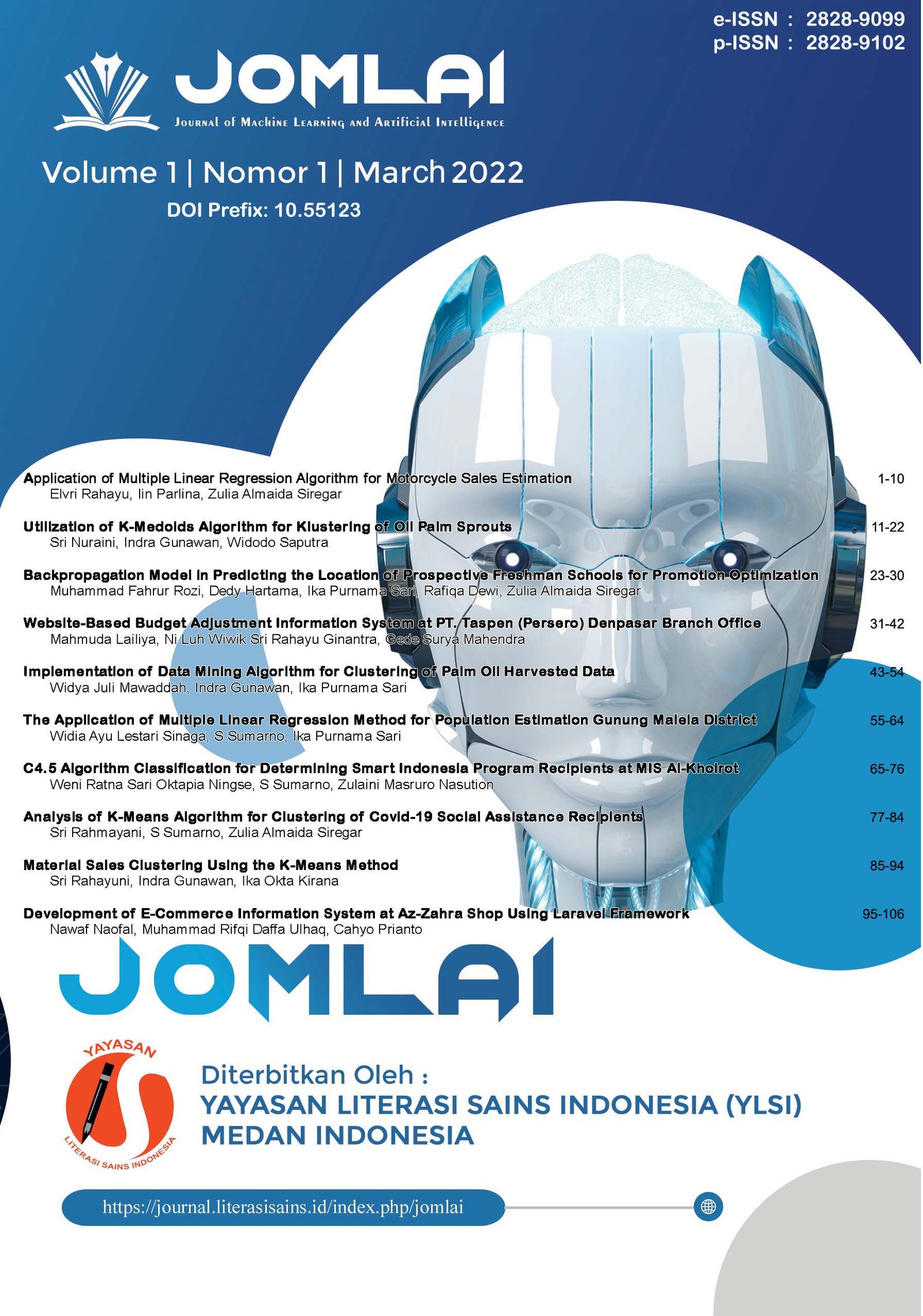
Backpropagation Model in Predicting the Location of Prospective Freshman Schools for Promotion Optimization
DOI:
https://doi.org/10.55123/jomlai.v1i1.161Keywords:
ANN, Predictions, Freshman Schools , Promotion OptimizationAbstract
In carrying out promotions, it is also necessary to pay for the manufacture of brochures, banners and other promotional media to provide information to prospective students and attract prospective students to register. Determining the location of the promotion is one of the success factors in promotional activities. In this study, the Artificial Neural Network will be used to predict the location of the promotion. Backpropagation is one of the best artificial neural network methods used for prediction, this method is widely used by researchers in predicting a problem. The data analysis tool used is Matlab or what we call the (Matrix Laboratory) which is a program to analyze and compute numerical data, and Matlab is also an advanced mathematical programming language, which was formed on the premise of using the properties and forms of matrices. From the results of the algorithm used, it is expected to get good accuracy results with some architectural experiments later. So that this research can be an indicator to optimize promotions in the following year in order to attract prospective students to register for AMIK and STIKOM Tunas Bangsa Pematangsiantar
References
W. Saputra, J. T. Hardinata, and A. Wanto, “Implementation of Resilient Methods to Predict Open Unemployment in Indonesia According to Higher Education Completed,” JOURNAL OF INFORMATICS AND TELECOMMUNICATION ENGINEERING, vol. 3, no. 1, pp. 163–174, Jul. 2019.
N. L. W. S. R. Ginantra, M. A. Hanafiah, A. Wanto, R. Winanjaya, and H. Okprana, “Utilization of the Batch Training Method for Predicting Natural Disasters and Their Impacts,” IOP Conf. Series: Materials Science and Engineering, vol. 1071, no. 1, p. 012022, 2021.
T. Afriliansyah et al., “Implementation of Bayesian Regulation Algorithm for Estimation of Production Index Level Micro and Small Industry,” Journal of Physics: Conference Series, vol. 1255, no. 1, pp. 1–6, 2019.
Y. Andriani, A. Wanto, and H. Handrizal, “Jaringan Saraf Tiruan dalam Memprediksi Produksi Kelapa Sawit di PT. KRE Menggunakan Algoritma Levenberg Marquardt,” Prosiding Seminar Nasional Riset Information Science (SENARIS), vol. 1, no. September, pp. 249–259, 2019.
A. Wanto and J. T. Hardinata, “Estimations of Indonesian poor people as poverty reduction efforts facing industrial revolution 4.0,” IOP Conference Series: Materials Science and Engineering, vol. 725, no. 1, pp. 1–8, 2020.
A. Wanto, M. Zarlis, Sawaluddin, and D. Hartama, “Analysis of Artificial Neural Network Backpropagation Using Conjugate Gradient Fletcher Reeves in the Predicting Process,” Journal of Physics: Conference Series, vol. 930, no. 1, pp. 1–7, 2017.
B. Keshtegar, M. Hasanipanah, I. Bakhshayeshi, and M. Esfandi Sarafraz, “A novel nonlinear modeling for the prediction of blast-induced airblast using a modified conjugate FR method,” Measurement: Journal of the International Measurement Confederation, vol. 131, pp. 35–41, 2019.
M. H. Tinambunan, E. B. Nababan, and B. B. Nasution, “Conjugate Gradient Polak Ribiere in Improving Performance in Predicting Population Backpropagation,” IOP Conference Series: Materials Science and Engineering, vol. 835, no. 1, pp. 1–6, 2020.
H. Okprana, M. R. Lubis, and J. T. Hadinata, “Prediksi Kelulusan TOEFL Menggunakan Metode Resilient Backpropagation,” Jurnal Edukasi dan Penelitian Informatika (JEPIN), vol. 6, no. 2, p. 275, 2020.
G. W. Bhawika et al., “Implementation of ANN for Predicting the Percentage of Illiteracy in Indonesia by Age Group,” Journal of Physics: Conference Series, vol. 1255, no. 1, pp. 1–6, 2019.
A. Wanto et al., “Analysis of the Backpropagation Algorithm in Viewing Import Value Development Levels Based on Main Country of Origin,” Journal of Physics: Conference Series, vol. 1255, no. 1, pp. 1–6, 2019.
E. Siregar, H. Mawengkang, E. B. Nababan, and A. Wanto, “Analysis of Backpropagation Method with Sigmoid Bipolar and Linear Function in Prediction of Population Growth,” Journal of Physics: Conference Series, vol. 1255, no. 1, pp. 1–6, 2019.
M. K. Z. Sormin, P. Sihombing, A. Amalia, A. Wanto, D. Hartama, and D. M. Chan, “Predictions of World Population Life Expectancy Using Cyclical Order Weight / Bias,” Journal of Physics: Conference Series, vol. 1255, no. 1, pp. 1–6, 2019.
A. Wanto et al., “Analysis of the Accuracy Batch Training Method in Viewing Indonesian Fisheries Cultivation Company Development,” Journal of Physics: Conference Series, vol. 1255, no. 1, pp. 1–6, 2019.
Y. Andriani, H. Silitonga, and A. Wanto, “Analisis Jaringan Syaraf Tiruan untuk prediksi volume ekspor dan impor migas di Indonesia,” Register: Jurnal Ilmiah Teknologi Sistem Informasi, vol. 4, no. 1, pp. 30–40, 2018.
W. Saputra, J. T. Hardinata, and A. Wanto, “Implementation of Resilient Methods to Predict Open Unemployment in Indonesia According to Higher Education Completed,” JITE (Journal of Informatics and Telecommunication Engineering), vol. 3, no. 1, pp. 163–174, 2019.
N. L. W. S. R. Ginantra et al., “Performance One-step secant Training Method for Forecasting Cases,” Journal of Physics: Conference Series, vol. 1933, no. 1, pp. 1–8, 2021.
M. A. Hanafiah and A. Wanto, “Implementation of Data Mining Algorithms for Grouping Poverty Lines by District/City in North Sumatra,” International Journal of Information System & Technology, vol. 3, no. 2, pp. 315–322, 2020.
Downloads
Published
How to Cite
Issue
Section
License
Copyright (c) 2022 Muhammad Fahrur Rozi, Dedy Hartama, Ika Purnama Sari, Rafiqa Dewi, Zulia Almaida Siregar

This work is licensed under a Creative Commons Attribution-ShareAlike 4.0 International License.
Copyright (c) 2022 The authors. Published by Yayasan Literasi Indonesia  This work is licensed under a Creative Commons Attribution-ShareAlike 4.0 International License
The author(s) whose article is published in the JOMLAI journal attain the copyright for their article and grant the journal right of first publication with the work simultaneously licensed under a Creative Commons Attribution-ShareAlike 4.0 International License. By submitting the manuscript to JOMLAI, the author(s) agree with this policy. No special document approval is required.
The author(s) guarantee that:their article is original, written by the mentioned author(s),
- has never been published before,
- does not contain statements that violate the law, and
- does not violate the rights of others, is subject to copyright held exclusively by the author(s), and is free from the rights of third parties, and that the necessary written permission to quote from other sources has been obtained by the author(s).
The author(s) retain all rights to the published work, such as (but not limited to) the following rights:
- Copyright and other proprietary rights related to the article, such as patents,
- The right to use the substance of the article in its own future works, including lectures and books,
- The right to reproduce the article for its own purposes,
- The right to archive all versions of the article in any repository, and
- The right to enter into separate additional contractual arrangements for the non-exclusive distribution of published versions of the article (for example, posting them to institutional repositories or publishing them in a book), acknowledging its initial publication in this journal (JOMLAI: Journal of Machine Learning and Artificial Intelligence).
Suppose the article was prepared jointly by more than one author. Each author submitting the manuscript warrants that all co-authors have given their permission to agree to copyright and license notices (agreements) on their behalf and notify co-authors of the terms of this policy. JOMLAI will not be held responsible for anything that may arise because of the writer's internal dispute. JOMLAI will only communicate with correspondence authors.
Authors should also understand that their articles (and any additional files, including data sets, and analysis/computation data) will become publicly available once published. The license of published articles (and additional data) will be governed by a Creative Commons Attribution-ShareAlike 4.0 International License. JOMLAI allows users to copy, distribute, display and perform work under license. Users need to attribute the author(s) and JOMLAI to distribute works in journals and other publication media. Unless otherwise stated, the author(s) is a public entity as soon as the article is published